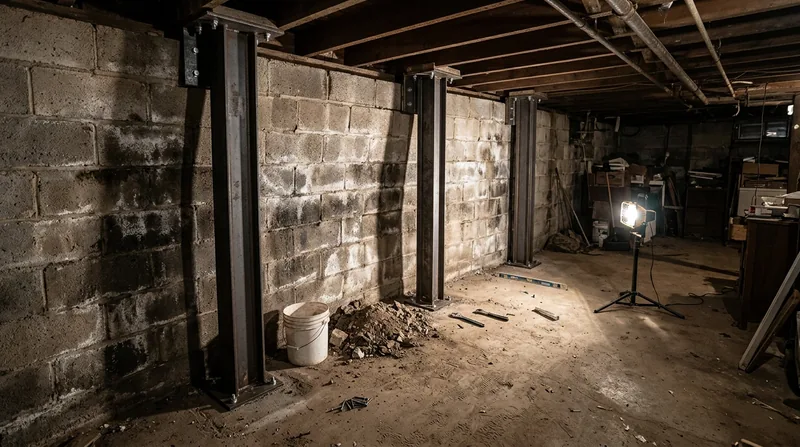




If you own one of the older brick or block houses on the Tree Streets or down in Keystone, you have probably noticed a wall that leans in a little more each year. Bowing wall repair in Johnson City is the work of stopping that movement before the wall fails, and it is a different job from sealing a crack or pumping water out of a basement. Our city sits on limestone bedrock with a thin clay cover, so spring storms and freeze-thaw cycles load the walls from behind while the footing stays put. We stabilize leaning block, stone, and poured walls with carbon fiber straps, steel I-beams, or wall anchors matched to how far the wall has moved. If you are already fighting water at the same wall, start with our basement waterproofing service so the pressure gets relieved and the repair holds.
Why Bowing Walls Show Up So Often in Johnson City and Washington County
The ground here is karst limestone under a shallow clay cap. Rain sinks fast through open seams, then the clay holds it against the foundation, and the wall takes the load. Add the freeze-thaw cycles we get most winters and the hydrostatic pressure behind an old block wall climbs until the middle of the wall pushes inward. That pattern shows up hardest on the 1900s to 1930s houses near Downtown and Keystone, where stone and early block foundations were never built for today's water volume.
- You see a horizontal crack in the mortar joints near the middle of the wall, often with the wall leaning in above it.
- Doors and windows on the upper floor start sticking because the wall movement has shifted the framing.
- White efflorescence powder appears where water pushes through the block and evaporates on the face.
- The wall pulls away from the floor joists, leaving a gap at the top plate that you can see from inside.
- Parging or plaster on the inside face cracks in a horizontal line and starts to bulge.
Any one of those signs is worth a look before the next wet spring, because movement accelerates once the wall is out of plumb.
Key info: A block wall on a 1920s house near Keystone had leaned about two inches at mid-height after years of water from an uphill lot. The fix was carbon fiber straps on the inside face plus a relief path for the water, not a full rebuild. The wall has held plumb since.
For the structural side of the code and permit questions, the City of Johnson City Building Department is the authority to check with before any wall stabilization work begins: johnsoncitytn.org.
How We Diagnose and Repair a Bowing Wall in Johnson City
We start by finding out what is pushing the wall, not just how far it has moved. A plumb reading, a look at the mortar joints, and a moisture check along the base tell us whether the driver is wet clay, a blocked footing drain, or a spring feeding the backfill. From there we match the repair to the severity: straps for early movement, beams or anchors for a wall that has gone further. If the water is the real problem, the wall repair alone will not hold, and we say so.
- We measure the wall's plumb and map the crack pattern so we have a baseline to compare against later.
- We check the footing drain and the grading around the wall to see where the water is coming from.
- We relieve the pressure with an interior perimeter drain and sump basin where the water is the driver.
- We install carbon fiber straps, steel I-beams, or wall anchors, anchored to the floor and the joists above.
- We seal the wall face and verify the repair with a second plumb reading before we leave.
The order matters. Relieving water first is what keeps a strap repair from being loaded again the next spring.
Key info: A split-level off University Parkway had a block wall leaning about an inch and a half, with water showing at the low corner after every storm. We put in an interior drain tile system first, then strapped the wall. Two seasons later the plumb reading has not moved.
Where the movement has opened a clean vertical crack and the wall is still plumb, sealing may be all you need. That is a different job, covered on our foundation crack repair page.
Repair Methods We Use and When Each One Fits
No single method fits every wall. The right choice depends on how far the wall has moved, what kind of wall it is, and how much water is loading it from behind. Here is how we match the approach to the condition we find.
| Approach | Description | Best for |
|---|---|---|
| Carbon fiber straps | Straps bonded to the inside face and anchored top and bottom to resist further inward movement. | Block walls with early movement, up to about two inches out of plumb. |
| Steel I-beams | Vertical beams set against the wall and tied into the floor and joists to brace the wall. | Longer walls and heavier movement where straps alone are not enough. |
| Wall anchors | Plates set in the yard outside tied through the wall to an inside plate, pulling it back over time. | Walls that have moved further and can be straightened rather than just held. |
| Drainage relief first | Interior perimeter drain and sump basin to take the water load off the wall before bracing. | Any wall where wet clay or a failed footing drain is the driver. |
We tell you plainly when a strap repair is enough and when the wall needs anchors, and we do not sell a structural fix for a problem that is really drainage.
Bowing Wall Repair Cost in Johnson City: What to Expect
Most bowing wall repairs in Johnson City start around $600 for the smallest jobs, such as a short strap repair on a single wall section with no water problem behind it. From there the price climbs with the number of straps or beams, the length of the wall, and whether we have to relieve water first. A wall that needs anchors or a full interior drain system is a bigger job, and we price it after we see the wall.
The biggest cost driver is not the wall itself but what is behind it. A wall loaded by wet clay and a failed footing drain needs the water handled or the repair will not last. Access matters too: a finished basement means moving stored items and protecting the floor before we can work, and a wall under a porch or a tight side yard takes longer. Age and wall type count as well, since old stone and early block take more care than poured concrete. Get two or three estimates and compare what each one actually includes, not just the bottom line. Our pricing page lays out the ranges in more detail.
Bowing Wall Repair Near Me: How to Choose a Contractor Near Johnson City
Bowing wall work is structural, so the contractor you pick matters more than the price. Ask for proof of licensing and insurance before anyone touches the wall, and get the certificate sent to you, not just a verbal yes. Get at least two or three written estimates that spell out the method, the materials, and what happens if the wall moves again. Ask for references from jobs in Johnson City and the surrounding towns, and call them.
Permits are commonly required for structural foundation repair, and the rules vary by jurisdiction, so confirm with the local building department before work starts. If your house sits in a neighborhood with its own rules, check those too. A contractor who hesitates to put the method and the warranty in writing is one to pass on. Reach out through our contact page to set up a look at your wall.
Bowing Wall Repair in Johnson City: Pricing Guide
| Service | Price | Details |
|---|---|---|
| Single wall section, carbon fiber straps | Starting at $600 | Includes plumb reading, strap layout, and installation on one short wall section with no water problem behind it |
| Full wall strapping or steel I-beams | Starting at $1,800 | Covers a full wall run with multiple straps or beams tied into the floor and joists above |
| Wall anchors with straightening | Starting at $3,500 | For walls that have moved further and can be pulled back over time, priced by wall length and access |
| Drainage relief added first | On estimate | Interior perimeter drain and sump basin priced after we see where the water is coming from |
| Estimate | Free | Response within 24h at (423) 427-2632, no obligation to book |
Indicative pricing, the exact cost depends on square footage, finish, and site access. Free personalized estimate within 24h at (423) 427-2632.


